Search for an n8n marketing agency and you mostly get template galleries. Thousands of pre-built workflows, free to import, each one a screenshot of somebody else’s stack. They are genuinely useful. They are also the reason the question keeps coming up: if the templates are free, what exactly is an agency for?
The short answer is that the workflow was never the hard part. Here is the longer one.
What you are actually buying
An n8n engagement looks like three separate things that get sold as one. It is worth knowing which of them you need, because you might only need one.
The build. Someone models your process, decides what n8n should own and what it should stay out of, and wires it. This is the part that looks like the templates, and it is usually the smallest share of the work.
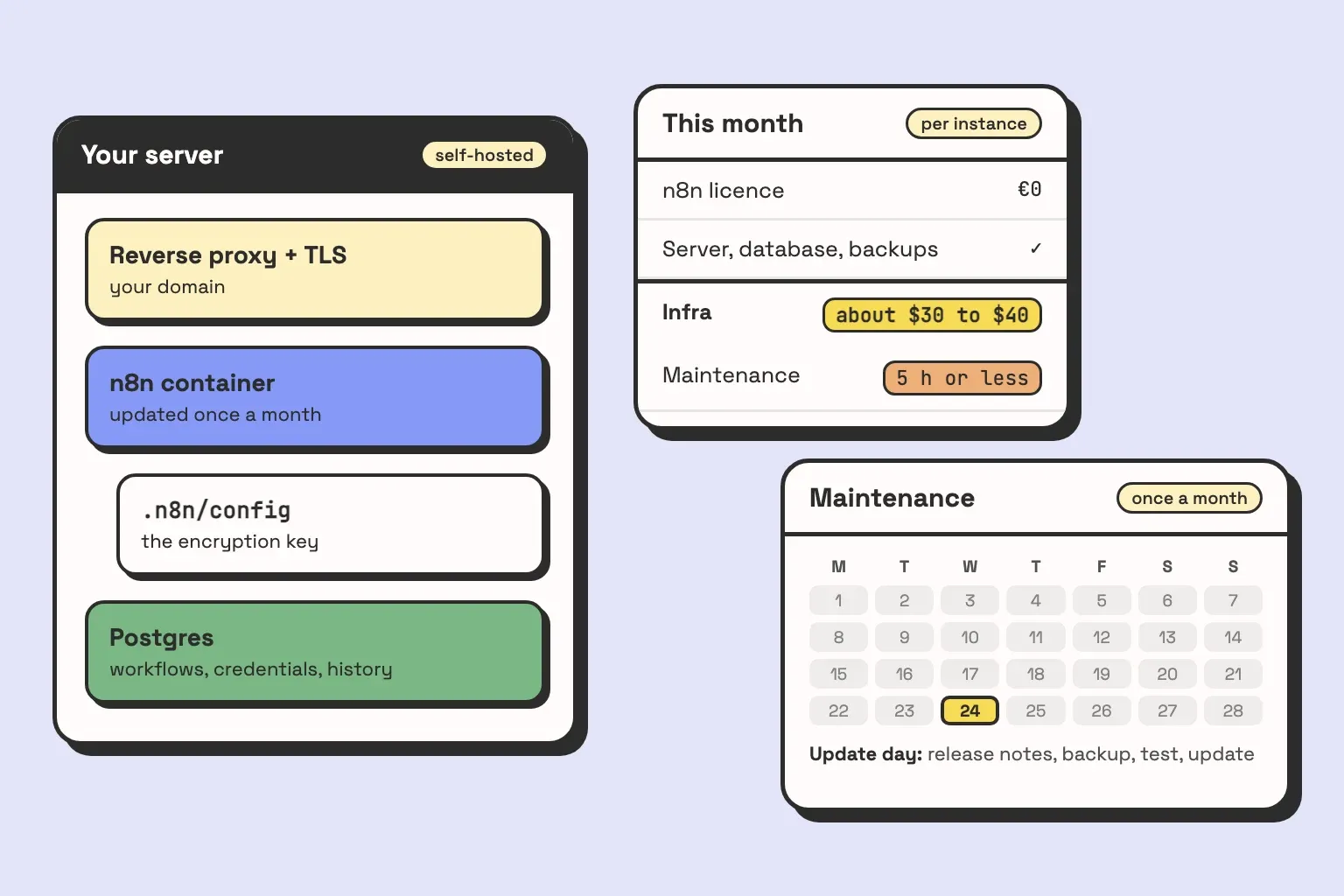
The hosting. n8n self-hosted is free the way a puppy is free. You are now running a service: a server, a database, backups, version upgrades that occasionally change node behaviour, and credentials for every system it touches sitting in one place. Someone owns that. If nobody has been named, the answer is nobody.
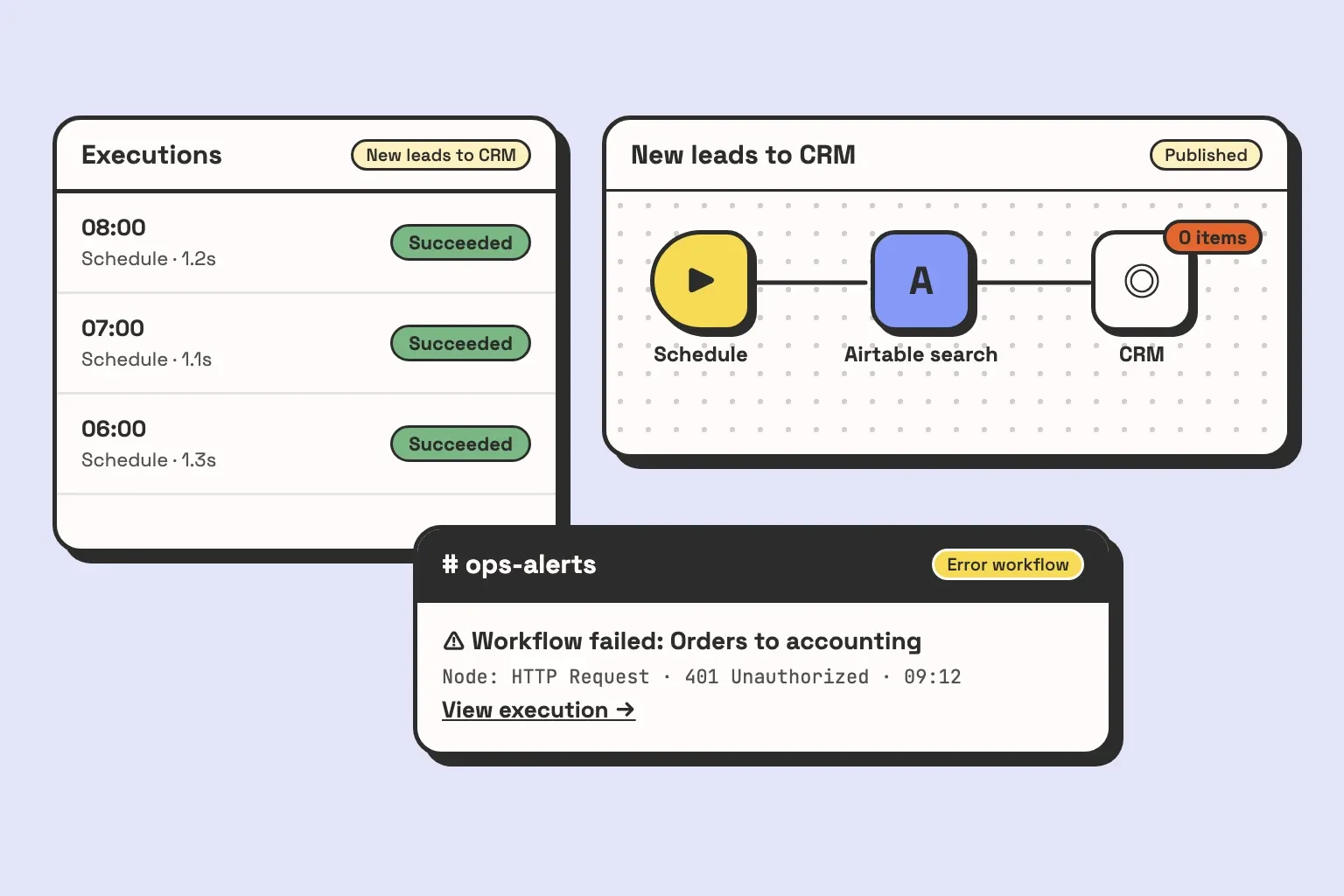
The maintenance. APIs change. A vendor deprecates an endpoint, a token expires, a rate limit tightens. A workflow that ran perfectly for seven months stops, and it usually stops quietly. The records just do not appear, and that is the part that costs real money.
Most teams come to an agency thinking they are buying the first thing. They are usually in trouble because of the third.
Two systems we built with n8n
Two we have built, and the part of each that was actually hard.
Product capture from any vendor site
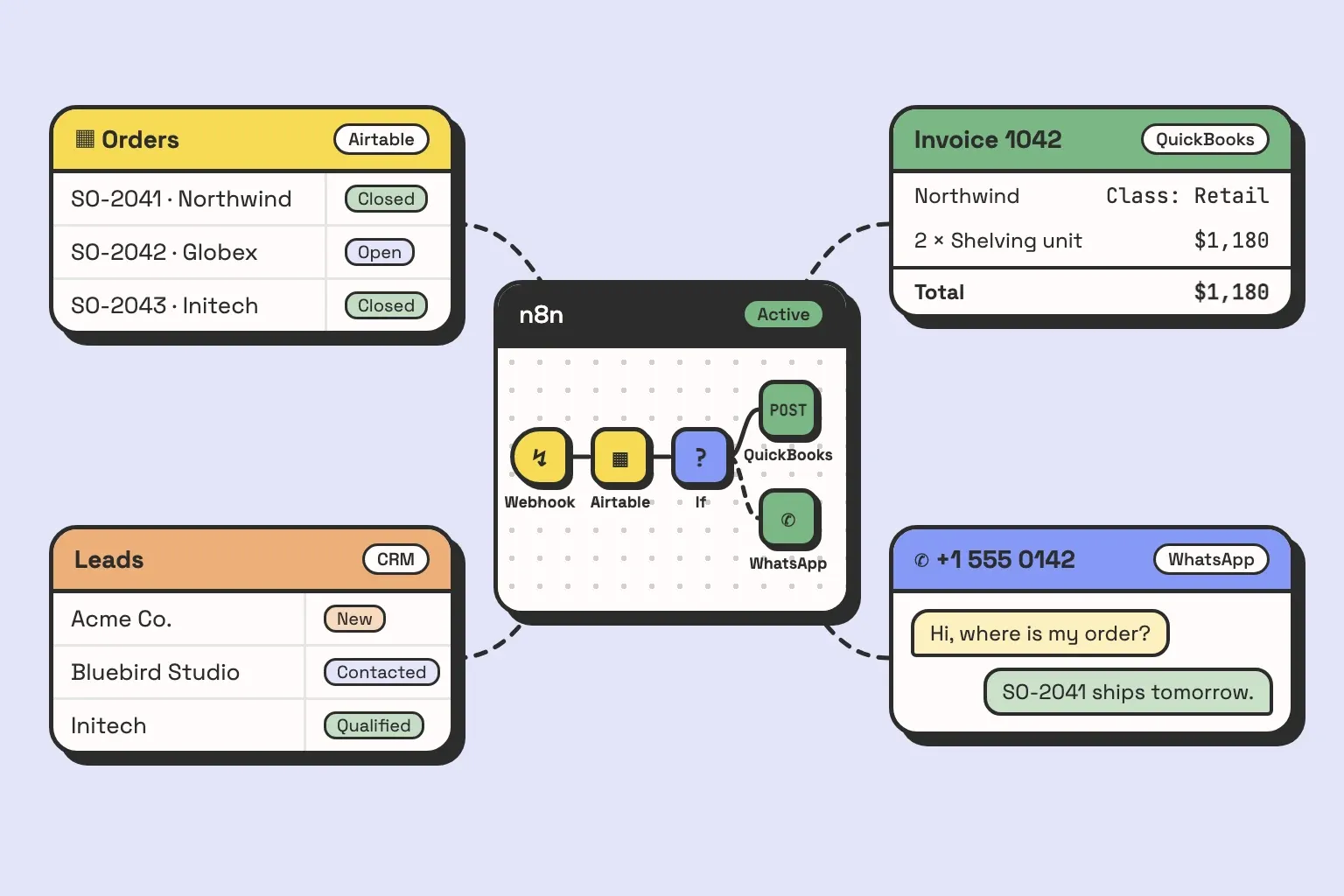
A browser extension that clips a product (vendor, price, image, specs) from any supplier page straight into Airtable. n8n sits between the extension and the base.
The clipping was not the hard part. Every vendor site marks up a price differently, and half of them load it after the page renders. The work was in the normalisation layer: deciding what counts as a price when a page shows three, and what to do with the ones that do not parse rather than silently writing a null into a project budget.
A WhatsApp agent that answers from your own data
Customers message on WhatsApp. The agent answers from Airtable, using the same base to verify who they are before it says anything. Every thread lands in a web console where the team can watch, take over mid-conversation, and tune the responses.
The interesting constraint was the order of operations. The agent verifies the customer before it generates a word, because an assistant that helpfully reads out an order status to whoever happens to message is not a feature. n8n orchestrates that sequence, and the sequence is the product.
What both have in common: n8n is the connective tissue, not the intelligence and not the system of record. The moment a project treats n8n as the database, it starts going wrong.
Agency, hire, or do it yourself
Which one fits depends on how much automation work you expect to have next year, not on how much you have today.
| Makes sense when | Breaks when | |
|---|---|---|
| DIY | One or two workflows, no compliance surface, someone on the team genuinely enjoys this | That person leaves, or gets busy, and nobody else can read the canvas |
| Hire in-house | Automation is continuous and central, and you will always have a queue of work | You need three skills (integration, data modelling, infrastructure) and budget for one salary |
| Agency | You need a system live on a deadline, or you have one that is failing and nobody can say why | The scope is genuinely one workflow. You will pay engagement overhead for a job that takes an afternoon |
The most useful question is not “can we build this ourselves?” It is usually yes. The question is whether you want to be the team that owns it at 6pm on a Friday eighteen months from now. If you decide to hire someone, what to ask an n8n developer before you hire them turns that into six screening questions.
What self-hosting actually commits you to
This is the part that surprises people, so it is worth being specific. Choosing self-hosted n8n over a managed plan means you have taken on:
- A server that must stay up, because a workflow that only runs when the box is healthy is not automation, it is a cron job with good intentions.
- A database with a backup you have tested. Untested backups are a belief, not a backup.
- Upgrades. n8n moves quickly. That is mostly good and occasionally means a node behaves differently than it did last month.
- Credentials for every connected system in one place. Whatever your security posture is, this is now part of it.
- Monitoring, because the failure mode is silence. The workflow does not crash loudly; the record simply never arrives, and you find out when a customer asks.
None of that is an argument against self-hosting. We run plenty of it. It is an argument against choosing it because it is free, which is the reason most teams choose it.
What an engagement looks like
Ours is fixed scope and fixed price, with the first system live in under four weeks, and it starts with a call rather than a quote, because the honest scope is usually not the one in the initial brief. Across 1,500+ workflows the pattern is consistent: the process someone describes and the process that actually runs differ in two or three places, and those places are where the automation would have broken.
The shape:
- A call to find the real bottleneck, which is frequently not the one you came in about.
- A scope with a fixed price, so the conversation stops being about hours.
- A build, in stages, with the first working piece in your hands early rather than a reveal at the end.
- A handover that includes documentation, because a system only you can maintain is a system we have failed to deliver.
When you do not need an agency
Four cases where hiring anyone is the wrong move:
- It is one workflow with two steps. Use a template. Use Zapier. You will spend more time briefing an agency than building it.
- Your process is not settled. Automating a process you are still arguing about hard-codes the argument. Settle it first.
- The real problem is your data. If the underlying records are a mess, automation propagates the mess faster. Fix the model first. That is a different engagement, and a cheaper one.
- You want to learn n8n. Then build it. Genuinely. The documentation is good and the community is active.
If you are still reading and none of those fit, the useful next step is a conversation about what is actually breaking. Book a call and we will tell you if it is a job worth hiring for.
The honest summary
An n8n agency is not selling you workflows; the templates already gave those away. It is selling you the judgement about what to automate, the data modelling underneath it, and someone whose job it is to notice when it stops. If you have that in-house, you do not need us. If you do not, that is the gap, and it is cheaper to fill before the silent failure than after.
If you are still deciding between platforms, our comparison of Zapier, Make and n8n covers where each one fits. If you are earlier than that, what workflow automation actually is is the better starting point. And if your stack is Airtable-shaped rather than n8n-shaped, the questions are similar but the answers differ. Hiring an Airtable consultant covers that side.